Healthcare PE consolidation: beyond the morality debate
A practical, ownership-neutral view of private equity in healthcare: where capital can help, where control can harm, and how providers, payers, patients, communities, and regulators should judge the tradeoffs.
Private equity in healthcare usually arrives as a morality play. One side sees capital, management discipline, better technology, and a lifeline for independent practices. The other sees debt, staffing cuts, price hikes, billing games, and investors who exit before the damage shows.
Both sides are describing something real. The framing is just too blunt to be useful. Healthcare is not one market, and PE is not one operating model. A rural hospital, a dermatology platform, an anesthesia staffing company, a hospice, a dental support organization, a payer-tech business, and a cardiology group with its own cath lab each carry different risks. The question that predicts harm is narrower: where does the investor take control? The clinician, the license, the site, the payer contract, the referral stream, the real estate, the revenue cycle, or the exit.
That is the whole argument in one line. Capital is not the variable that decides outcomes. Control is. The same dollar can fund a builder that leaves a practice stronger or a miner that strips it and moves on, and at signing the paperwork looks much the same.
Two decades in the making
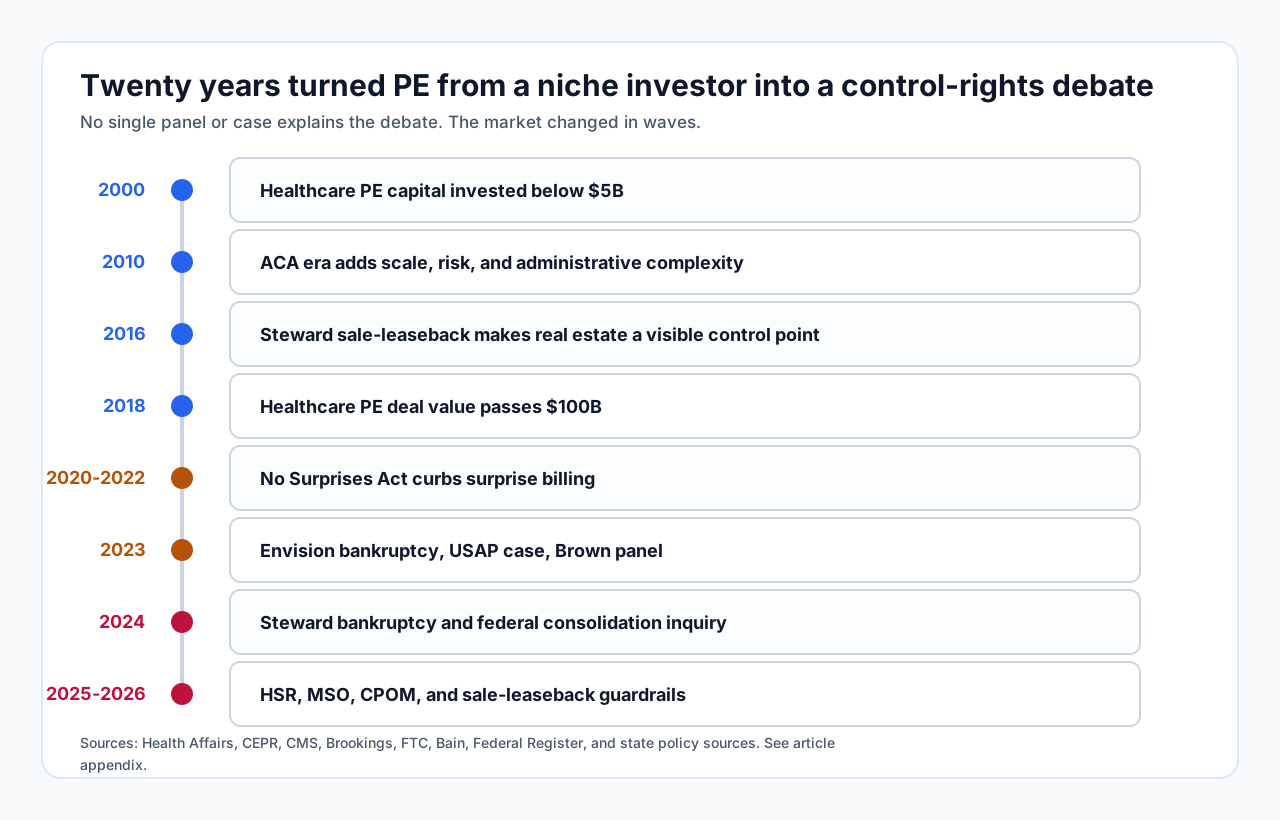
The control question has been building for more than twenty years. Private equity capital in healthcare grew from under $5 billion in 2000 to more than $100 billion in 2018, per research cited in Health Affairs and CEPR. Roughly 70% of that investment landed after the Affordable Care Act passed in 2010.[1][2] The ACA did not summon the capital. The post-2010 system simply became more complex, more consolidated, and easier to run at scale, which rewarded owners who could manage contracting, compliance, and fragmented local ownership.
From there the fight moved through concrete episodes: surprise billing and hospital-based staffing, the No Surprises Act, Envision’s bankruptcy, Steward’s collapse, the FTC’s anesthesia roll-up case, nursing-home ownership disclosure, and a wave of state laws aimed at MSOs and sale-leasebacks.[3][4][5][6] Brown University’s 2023 panel, “Private Equity and the Future of US Healthcare,” framed PE as a third wave of consolidation and a symptom of market failure.[7] That panel sits in the middle of the story, though, not at its start.
The market never cooled. Bain put global healthcare PE deal value at $115 billion in 2024, its second-highest year on record, and its 2026 report puts 2025 at a record $191 billion, with provider and related services deal value up 57% over the prior year.[8][9] Exits tell a different story. Hold periods peaked in 2024 and sponsors have leaned on continuation funds to pace realizations, which raises the temptation to pull cash out through dividends and recapitalizations while assets wait.[31] Regulators kept pace, turning toward roll-ups, MSOs, ownership opacity, sale-leasebacks, noncompetes, and transaction review.
So the question has sharpened into three parts: what kind of capital, wired to what kind of control, operating in what kind of local market.
The national average hides the local reality
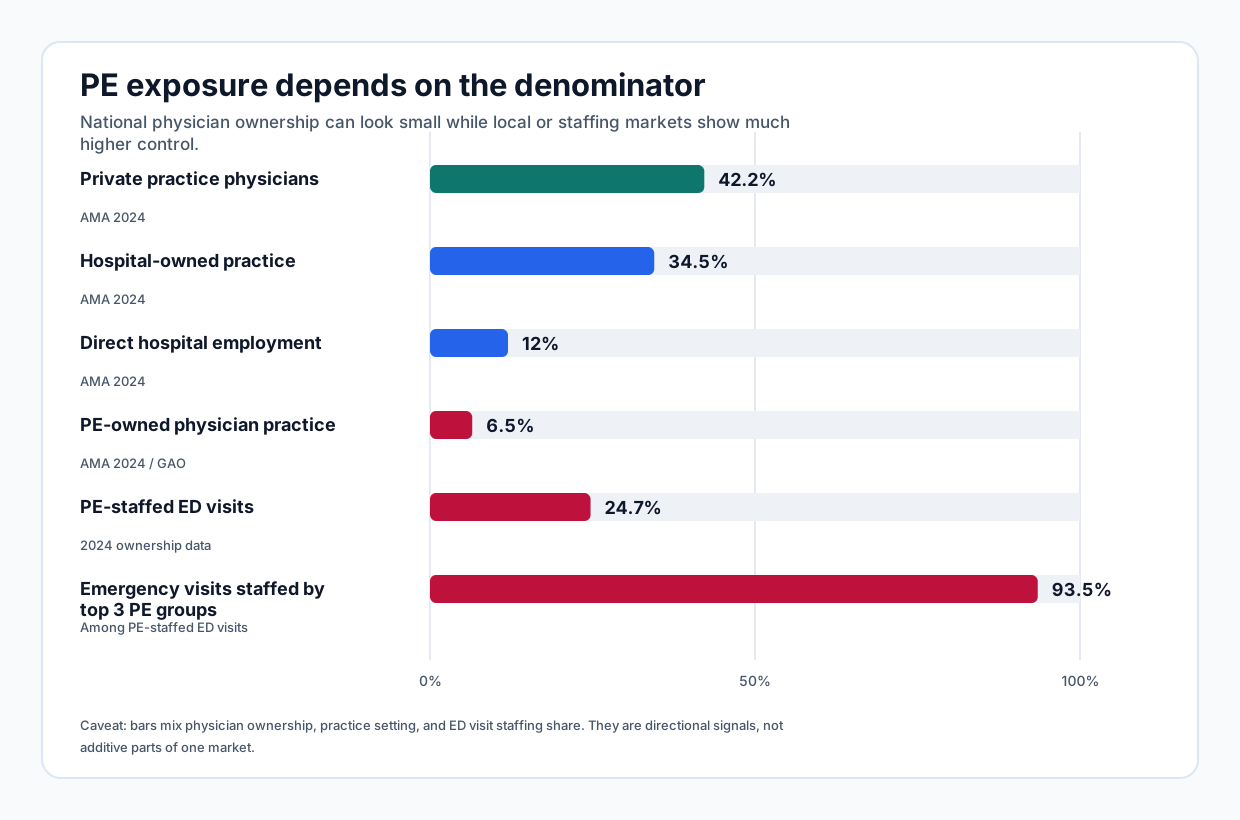
Start with the number everyone cites, because on its own it misleads. GAO’s 2025 review put PE ownership at about 6.5% of physicians nationally in 2024.[17] At that level PE sounds like a rounding error.
Local specialty markets say otherwise. A 2025 study using 2024 data found PE-backed groups staffed 24.7% of emergency-department visits in its sample, and the top three groups accounted for 93.5% of those PE visits.[18] In cardiology, a 2024 study in the Journal of the American College of Cardiology counted 342 PE-acquired clinics over a decade, with 94% of the deals closing between 2021 and 2023.[19] Penetration clusters by specialty, by metro, and by referral basin.
That gap between the national average and the local concentration is where the risk sits. A patient does not live in the national average. They live in one metro, with one anesthesia group covering their hospital, one cardiology platform taking most of the referrals, one nursing home with an open bed. Control gets exercised locally, so it has to be measured locally.
The case for PE
The strongest case for PE starts with what physicians already feel. Independent practice keeps getting harder to run. Rates are tight; CMS cut the 2025 physician fee schedule conversion factor by 2.83%, one more squeeze on fee-for-service revenue.[31] Payer contracting takes real expertise. Compliance, cybersecurity, recruiting, value-based care, and revenue-cycle work have all become permanent overhead.
The AMA’s 2024 benchmark found 42.2% of physicians in private practice, 34.5% in hospital-owned practices, and 12% directly employed or contracted by hospitals. About 6.5% described their practice as PE-owned, up from roughly 4.5% in 2020 and 2022. Among doctors who sold in the prior decade, the reasons clustered around inadequate payment, the cost of needed resources, and payer administrative burden.[10]
That is the opening. To a physician-owner, PE can mean liquidity and a buyer that is not the local hospital. To a practice, it can mean help with recruiting, contracting, billing, technology, procurement, and de novo growth. To a fragmented specialty, it can assemble enough scale to buy infrastructure no single group could afford.
The industry makes this case directly. The American Investment Council credits private capital with supporting access, research, facility upgrades, health data, and rural care.[11] The argument holds up best away from the exam room. Healthcare IT, life-sciences services, payer infrastructure, medtech, and provider-enablement businesses can absorb private capital without putting an investor between a clinician and a patient, and Bain’s recent reports show heavy activity in exactly those categories.[8][9]
The outcome evidence refuses to hand either side a clean win. A 2025 AMA Journal of Ethics review warned against grading PE ownership as uniformly good or bad, since results move with sector and metric.[12] A 2026 JAMA Health Forum study of primary-care acquisitions found no meaningful change in all-cause or preventable hospitalizations and a modest drop in emergency-department visits.[13]
So the honest pro-PE case is narrow. Some operators need capital. Some need management. Some PE-backed models do run better. Sound policy should target harmful conduct and harmful control rights, and leave ordinary capital alone.
The case against PE
The case against PE begins where healthcare least resembles a normal market. Patients frequently cannot shop, wait, judge quality, or switch. Someone in an emergency department, a nursing-home resident, a hospice patient, or a town with one hospital has almost no leverage. Debt, short hold periods, related-party fees, staffing cuts, and real-estate monetization all bite harder when the customer cannot walk away.
The recent evidence gives critics plenty. HHS’s January 2025 consolidation report catalogued concerns about higher prices, reduced access, lower quality, and ownership opacity.[14] A JAMA study tied PE hospital acquisition to more hospital-acquired adverse events, including falls and central-line infections.[15] A BMJ systematic review found PE ownership most consistently linked to higher costs for patients or payers, with quality effects ranging from mixed to negative.[16] A growing body of work now examines staffing, patient experience, surgical mortality, physician turnover, and specialty access, with results that vary by setting.
Then came the hospital failures. Steward and Prospect turned PE from a specialty-roll-up story into a community-solvency story. PE has no monopoly on bad owners. What the collapses exposed is how sale-leasebacks, debt, dividends, and management fees can hollow out a hospital’s balance sheet until a downturn in reimbursement, labor, or credit finishes the job.
Underneath all of it sits one structural fact. Healthcare has an unusual number of seams where financial control can be pried apart from clinical accountability. PE is very good at working those seams.
Who controls the practice
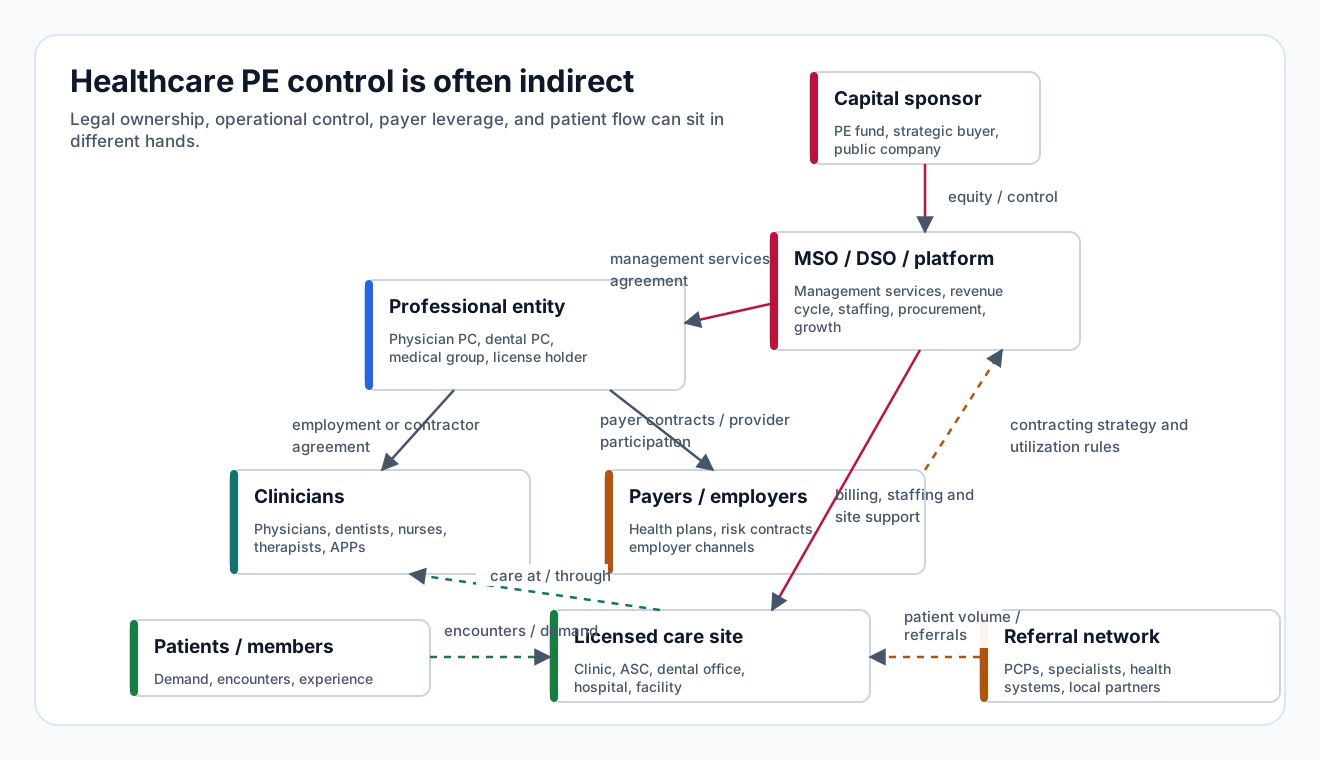
Most of the control in healthcare PE lives in a structure patients never see. Most states apply some version of the corporate practice of medicine doctrine, which bars non-physicians from owning a medical practice or directing clinical judgment. Capital gets around that wall with a two-box design.
The first box is the professional corporation. A licensed physician owns it, and it holds the license, employs the clinicians, and bills for care. The second box is a management services organization, owned by the investor, and it owns nearly everything else: the staff, the systems, the real estate, the contracts, the brand, the billing engine. A long-term management agreement routes most of the practice’s economics to the MSO as fees. A stack of side agreements gives the MSO the right to seat the physician-owner, and to replace them. The physician owns the practice on paper. The MSO controls what happens inside it day to day. This is the “friendly physician” model, and it is why “who owns it” answers less than it appears to.
None of this is abusive by default. The same two-box structure can house a real builder that funds new sites, better systems, and genuine clinical support. The structure just makes the extractive version easy to hide, because the terms that matter live in the management agreement and the equity documents, not in anything a licensing board or a patient ever reads.
Dentistry has run this structure the longest. The dental support organization is the same two-box design, and it is the model behind our own work with a community dental group. More than 100 PE-backed DSOs now operate, yet only about a quarter of the roughly 200,000 US dental practices are DSO-affiliated, the kind of fragmentation that keeps pulling capital in.[31] In the management agreements we have reviewed, control rarely announces itself. Ownership of the professional corporation stays with the physician, which keeps the licensing board satisfied, while the management agreement sets the fee that absorbs most of the practice’s margin, the budget that governs hiring and equipment, and the conditions under which the physician-owner can be swapped out. The pages that decide who is actually in charge are usually the least-negotiated ones at signing, sitting behind the valuation the seller came to discuss. What we have seen hold up repeatedly is that the real leverage lives in the fee schedule and the reserved rights, and a seller who reads only the purchase price learns that later, once the reinvestment and staffing calls start landing on someone else’s desk.
Oregon wrote this mechanism into law. Its 2025 statute, SB 951, bans the friendly-physician model, caps MSO control, voids stock-restriction agreements, and makes many noncompete, nondisclosure, and nondisparagement clauses unenforceable, as Georgetown’s Center on Health Insurance Reforms details.[21] New management companies formed since the law comply as of January 2026, and those already operating have until January 2029, a multi-year runway for structures already in place. The statute reaches past who owns the practice to who actually controls it.
Providers: the seller is not the workforce
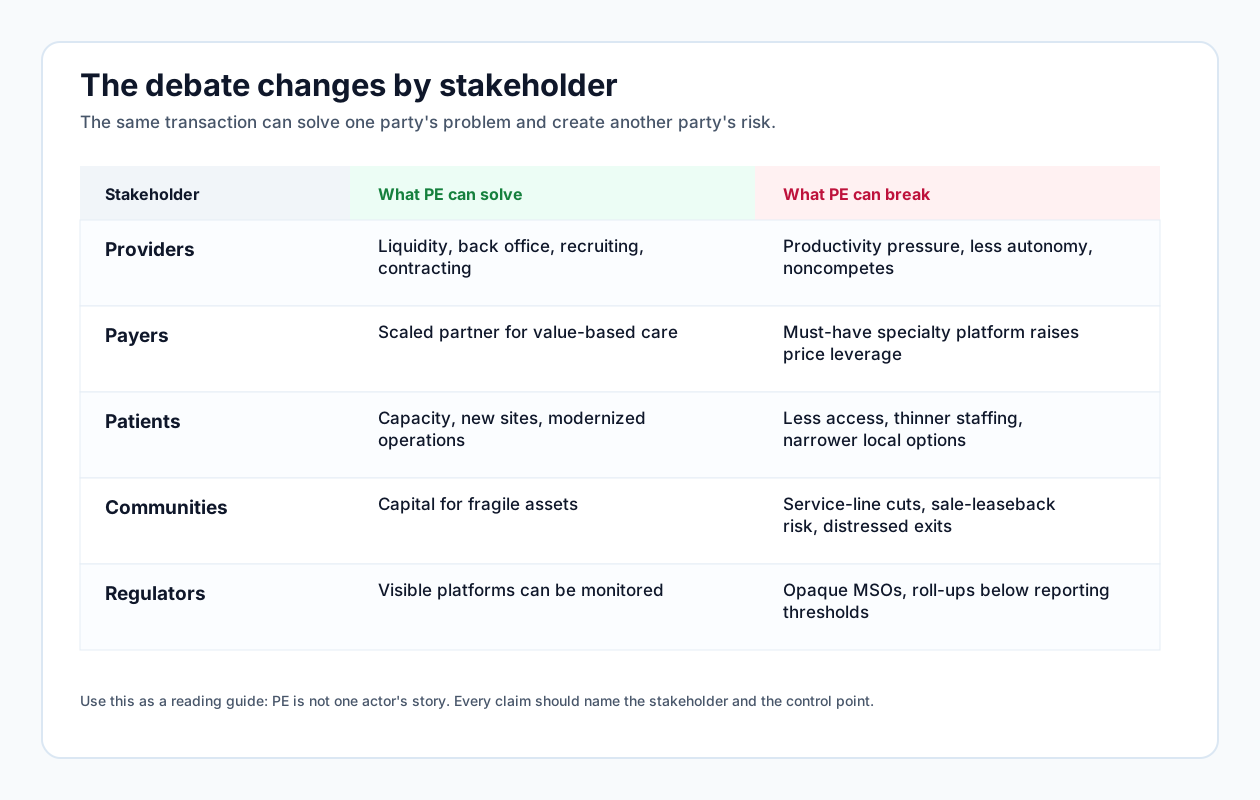
Provider interests split the moment a deal closes. The physician-owner who sells can do well: liquidity, less admin, better contracting, a diversified retirement, a growth partner. The clinicians who stay inherit a different deal, one they never got to price. Productivity targets. Staffing changes. Thinner autonomy. Noncompetes. Referral pressure. A narrower way out.
This matters because PE deals get defended as voluntary physician choices. They are voluntary for the seller. The people who carry the operating model forward, the associates, employed physicians, advanced-practice clinicians, nurses, therapists, and hygienists, never signed the purchase agreement.
Regulators have started aiming at that gap. The FTC’s April 2024 noncompete rule projected large gains in worker mobility and lower healthcare costs, but an August 2024 court order blocked it. In September 2025 the FTC abandoned its appeal and let the rule be vacated, moving to case-by-case enforcement against individual employers instead.[20] For now, noncompetes and clinical-autonomy protections live mostly in state law and private contracts, which is exactly the layer Oregon just moved on.
Payers and employers: partner or price lever
Payers and employers get both versions of PE. A backed platform can be a more capable contracting partner, fund value-based infrastructure, and shift care to lower-cost outpatient settings. The same platform can become a local price lever once it gets big enough.
Market structure decides which one shows up. A PE-backed primary-care group in a competitive metro can help a payer manage total cost of care. A dominant anesthesia, GI, dermatology, ophthalmology, or cardiology platform in a mid-sized market negotiates like a must-have.
The FTC’s case against U.S. Anesthesia Partners and Welsh Carson became the reference point, alleging a roll-up built to dominate anesthesia in Texas. The two defendants ended up on separate tracks. In May 2024 a federal court dismissed Welsh Carson from the lawsuit, finding its minority stake did not support an injunction against the firm. The FTC then pursued Welsh Carson administratively and finalized a consent order in May 2025 that limits its board rights and requires advance notice of future anesthesia deals. USAP stayed in the case and settled in April 2026, with the litigation stayed while the remedy is implemented.[22][23] The lesson here is leverage. Roll-up returns often depend on becoming essential to a network, a hospital, or a referral channel. Once a platform is essential, a payer’s ability to say no stops being real.
Patients and communities: access is the first question
Patient impact usually gets scored on quality metrics, but access is the sharper first question. Did the deal keep a hospital open? Close an unprofitable service line? Pull specialists out of Medicaid-heavy neighborhoods? Shorten visits? Change staffing? Leave the community with local options or without them?
This is why quality studies can feel unsatisfying. Mortality, readmissions, infections, patient experience, staffing, procedure volume, wait times, network adequacy, and service-line closures measure different things, and one transaction can look neutral on some and harmful on others. Capital that preserves capacity or modernizes care helps patients. Control over an essential local access point, a hospital, an ED, a nursing home, a hospice, held without durable reinvestment, is where patients get hurt.
Regulators: from ownership to control
Since 2023, regulators have moved from broad worry to specific tools. In March 2024, the FTC, DOJ, and HHS opened a cross-government inquiry into healthcare deals involving systems, payers, and PE funds, including transactions below Hart-Scott-Rodino thresholds.[24] In May 2024, the FTC and DOJ sought information on serial acquisitions, citing the 2023 Merger Guidelines’ recognition that roll-ups can violate antitrust law.[25] The revised HSR rule, effective February 10, 2025, widened premerger reporting.[26]
CMS finalized nursing-home ownership disclosure rules and defined PE company and REIT for Medicare enrollment.[27] Nursing homes now set the template for ownership transparency, though physician practices, hospices, behavioral health, ASCs, dental, and home health still sit outside it.
States are moving faster and with more precision. Massachusetts H.5159, signed January 8, 2025, expanded oversight after Steward and added visibility into PE, REITs, MSOs, and PBMs.[28] California’s governor vetoed AB 3129 in 2024, arguing existing bodies could review transactions, yet the bill itself showed how mainstream PE-specific oversight had become.[29] Connecticut’s 2026 PA 26-22 banned certain hospital main-campus sale-leasebacks, effective July 2027, and adds annual hospital attestations about PE interests and control starting February 2027.[30] The common thread runs from asking who owns a provider to asking who controls its economics.
Where this is heading
A prediction, stated plainly enough to be wrong. Oregon’s control-first approach, more than California’s transaction-review model or Massachusetts’s disclosure model, is the one other states copy. Control rules bite hardest because they reach the management agreement itself, and they are the hardest thing to restructure around. Over the next few years, expect a growing cluster of states to restrict MSO control rights, and any platform whose returns lean on those rights should already be discounting the change. The friendly-physician structure has a shelf life.
If that read is right, the healthcare investors who win from here are the ones whose model survives transparency, because their returns come from building capacity the law is happy to leave alone.
A test you can apply before you sign
The same test works whether you are a physician-owner weighing an offer, a sponsor trying to be the good kind of capital, or a regulator sizing up a deal. Judge the transaction by what it builds and what it controls.
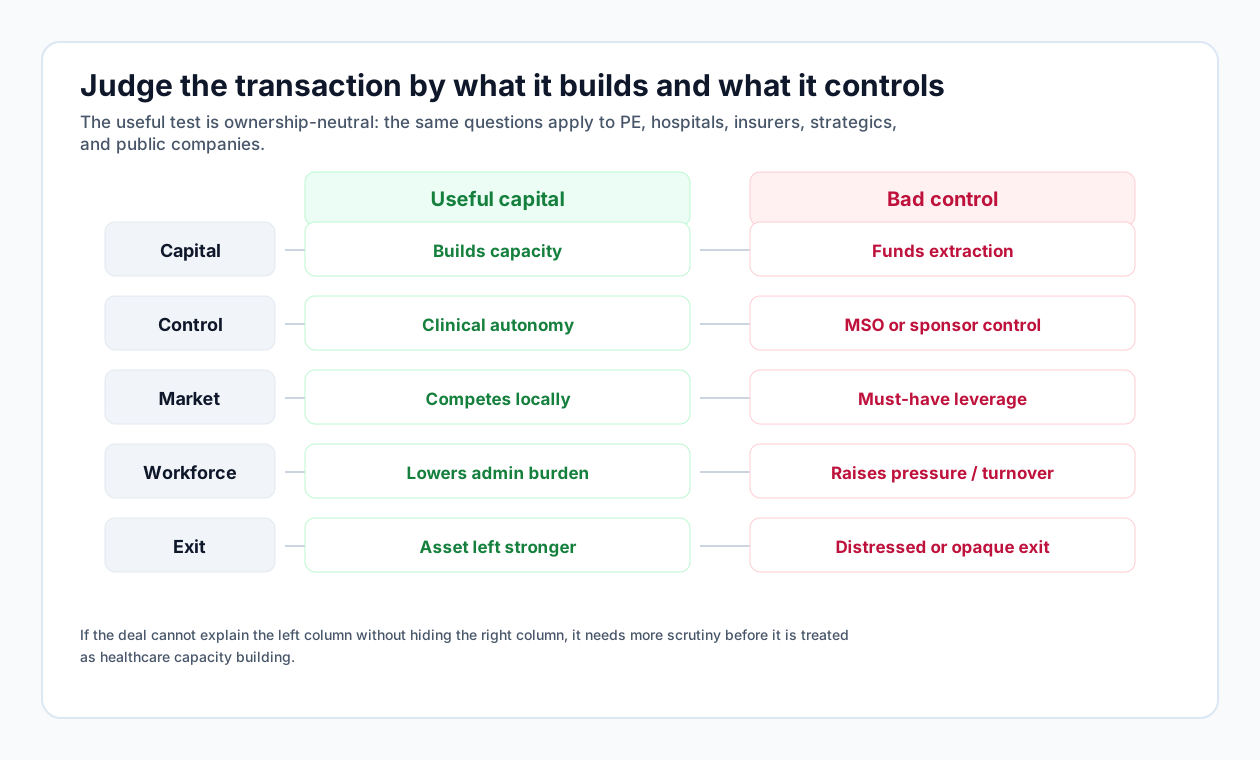
| Test | Good sign | Warning sign |
|---|---|---|
| Capital | Funds durable capacity, technology, staffing, access, or clinical infrastructure | Funds seller proceeds, debt service, dividends, fees, or sale-leaseback extraction without reinvestment |
| Control | Clinicians retain meaningful clinical autonomy and patients retain options | MSO, payer contract, staffing policy, referral model, or sponsor rights control care indirectly |
| Market structure | Platform competes in a fragmented market without becoming locally essential | Roll-up creates must-have local or specialty leverage |
| Workforce | Reduces administrative burden and improves recruiting or retention | Increases productivity pressure, turnover, noncompetes, NDAs, or staffing substitution |
| Exit | Buyer leaves the asset stronger and transparent | Exit depends on another financial buyer, a distressed sale, or public rescue |
The test is ownership-neutral on purpose. A nonprofit system, an insurer, a strategic acquirer, or a public company can consolidate a market and raise prices too. PE earns extra scrutiny because its model stacks the risk factors: leverage, finite hold periods, sponsor-level return targets, and control rights that can sit outside the clinical license.
Where this should land
Private equity is a stress test for the system. It reveals what the system already rewards. If payment rewards consolidation, capital consolidates. If regulators cannot see below HSR thresholds, small assets get rolled up quietly. If corporate-practice rules tolerate nominal physician ownership while MSOs hold the levers, that structure gets used. If hospitals can sell their land and lease it back without touching licensure or public review, someone runs that trade. And if independent physicians cannot survive the administrative and payer grind, they sell to whoever shows up: a hospital, an insurer, a chain, or a sponsor.
So the useful goal sits between banning PE and waving capital through: make good capital easier to accept and extractive control harder to hide. A builder leaves behind durable access, better operations, stronger clinical capacity, and an organization that outlasts the sponsor’s exit. A miner leaves higher prices, thinner staffing, fewer local options, opaque ownership, and a balance sheet that becomes someone else’s problem.
Healthcare needs the capital. It also needs rules, and buyers, that make capital behave like a builder instead of a miner.
Sources
[1] Health Affairs, “Private Equity Investments In Health Care: An Overview Of Hospital And Health System Leveraged Buyouts, 2003-17,” 2020: https://www.healthaffairs.org/doi/10.1377/hlthaff.2020.01535
[2] Appelbaum and Batt, “Private Equity Buyouts in Healthcare: Who Wins, Who Loses?” CEPR, 2020: https://cepr.net/wp-content/uploads/2020/03/WP_118-Appelbaum-and-Batt.pdf
[3] CMS, “No Surprises: Understand your rights against surprise medical bills”: https://www.cms.gov/newsroom/fact-sheets/no-surprises-understand-your-rights-against-surprise-medical-bills
[4] Holland & Knight, “Federal Bankruptcy Court Stays Envision Healthcare Litigation in Favor of Arbitration,” 2023: https://www.hklaw.com/en/insights/publications/2023/08/federal-bankruptcy-court-stays-envision-healthcare-litigation
[5] Brookings, “Lessons from the collapse of Steward Health Care,” 2025: https://www.brookings.edu/articles/lessons-from-the-collapse-of-steward-health-care/
[6] FTC case page, “U.S. Anesthesia Partners, Inc., FTC v.”: https://www.ftc.gov/legal-library/browse/cases-proceedings/2010031-us-anesthesia-partners-inc-ftc-v
[7] Brown University School of Public Health, “Private Equity and the Future of US Healthcare,” October 5, 2023 event / YouTube upload: https://www.youtube.com/watch?v=UhxcwIS8rUQ
[8] Bain & Company, “Healthcare Private Equity Market 2024: Year in Review and Outlook,” January 9, 2025: https://www.bain.com/insights/year-in-review-and-outlook-global-healthcare-private-equity-report-2025/
[9] Bain & Company, “Global Healthcare Private Equity Report 2026”: https://www.bain.com/insights/topics/global-healthcare-private-equity-report/
[10] American Medical Association, “More physicians move to practices owned by hospitals & private equity groups,” 2025: https://www.ama-assn.org/press-center/ama-press-releases/more-physicians-move-practices-owned-hospitals-private-equity
[11] American Investment Council, “Private Equity is Improving Health Care”: https://www.investmentcouncil.org/health-care-2/
[12] La Forgia and McDevitt, “How Should We Assess Quality of Health Care Services in Organizations Owned by Private Equity Firms?” AMA Journal of Ethics, 2025: https://journalofethics.ama-assn.org/article/how-should-we-assess-quality-health-care-services-organizations-owned-private-equity-firms/2025-05
[13] JAMA Health Forum, “Private Equity Acquisition in Primary Care and Avoidable Hospitalizations,” 2026: https://jamanetwork.com/journals/jama-health-forum/fullarticle/2848525
[14] HHS, “Consolidation in Health Care Markets RFI Response,” January 2025: https://www.hhs.gov/sites/default/files/hhs-consolidation-health-care-markets-rfi-response-report.pdf
[15] Kannan, Bruch, and Song, “Changes in Hospital Adverse Events and Patient Outcomes Associated With Private Equity Acquisition,” JAMA, 2023: https://jamanetwork.com/journals/jama/fullarticle/2813379
[16] Borsa et al., “Evaluating trends in private equity ownership and impacts on health outcomes, costs, and quality: systematic review,” BMJ, 2023: https://pmc.ncbi.nlm.nih.gov/articles/PMC10354830/
[17] GAO, “Health Care Consolidation: Published Estimates of the Extent and Effects of Physician Consolidation,” GAO-25-107450, 2025: https://www.gao.gov/products/gao-25-107450
[18] Annals of Emergency Medicine / ScienceDirect, “Emergency Physician Employer Market Share and Concentration by Ownership Type,” 2025: https://www.sciencedirect.com/science/article/pii/S0196064425009904
[19] “Private Equity Acquisitions of Outpatient Cardiology Practices in the United States, 2013-2023,” Journal of the American College of Cardiology, 2024: https://www.jacc.org/doi/10.1016/j.jacc.2024.06.011
[20] FTC, “FTC Announces Rule Banning Noncompetes,” April 2024, with later status updates: https://www.ftc.gov/news-events/news/press-releases/2024/04/ftc-announces-rule-banning-noncompetes
[21] Georgetown Center on Health Insurance Reforms, “Oregon’s Multi-Pronged Approach to Corporate Influence in Physician Practices,” 2026: https://chir.georgetown.edu/state-spotlight-oregons-multi-pronged-approach-to-corporate-influence-in-physician-practices/
[22] FTC, “FTC Approves Final Order with Welsh Carson,” May 2025: https://www.ftc.gov/news-events/news/press-releases/2025/05/ftc-approves-final-order-welsh-carson
[23] FTC case page, “U.S. Anesthesia Partners, Inc., FTC v.”: https://www.ftc.gov/legal-library/browse/cases-proceedings/2010031-us-anesthesia-partners-inc-ftc-v
[24] FTC, DOJ, and HHS cross-government healthcare consolidation inquiry, March 2024: https://www.ftc.gov/news-events/news/press-releases/2024/03/federal-trade-commission-department-justice-department-health-human-services-launch-cross-government
[25] FTC/DOJ serial acquisitions and roll-up strategies RFI, May 2024: https://www.ftc.gov/news-events/news/press-releases/2024/05/ftc-doj-seek-info-serial-acquisitions-roll-strategies-across-us-economy
[26] Federal Register, HSR final premerger notification rule, effective February 10, 2025: https://www.federalregister.gov/documents/2024/11/12/2024-25024/premerger-notification-reporting-and-waiting-period-requirements
[27] Federal Register, CMS nursing facility ownership disclosure final rule, November 17, 2023: https://www.federalregister.gov/documents/2023/11/17/2023-25408/medicare-and-medicaid-programs-disclosures-of-ownership-and-additional-disclosable-parties
[28] Massachusetts H.5159 bill history: https://malegislature.gov/Bills/193/H5159
[29] California Governor AB 3129 veto message, September 2024: https://www.gov.ca.gov/wp-content/uploads/2024/09/AB-3129-Veto-Message.pdf
[30] Connecticut PA 26-22 analysis, June 2026: https://www.healthlawdiagnosis.com/2026/06/connecticut-heightens-scrutiny-of-private-equity-in-healthcare-with-law-banning-hospital-sale-leaseback-agreements-and-requiring-private-equity-attestations/
[31] McGuireWoods LLP, “Private Equity in Healthcare and Life Sciences: An Updated Review of Select Subsector Investment Areas,” 2026 White Paper.